Monday, 24 March 2014

VART3457 - Experimental Practice [Patching Ideas]


From researching Wendy Carlos:

The Harmonic Scale:
 
is a "Super-Just" musical scale allowing extended just intonation, beyond 5-limit to the 19th harmonic (About this sound Play ), and free modulation through the use of synthesizers. It includes 144 (=12×12) notes per octave and two circles of fifths.[a] Transpositions and tuning tables are controlled by left-hand on the appropriate note on a one-octave keyboard.[1]
For example, if the harmonic scale is tuned to a fundamental of C then C is also the 16th and 32nd harmonics, C♯ is the 17th (About this sound Play ), D the 18th (About this sound Play ), E♭ the 19th (About this sound Play ), E♮ the 20th (About this sound Play ), F the 21st (a natural seventh above G, but not a great interval above C) (About this sound Play ), F♯ the 22nd (About this sound Play ), G the 24th (About this sound Play ), A♭ the 26th (About this sound Play ), A♮ the 27th (a just fifth above D) (About this sound Play ), B♭ the 28th (About this sound Play ), B♮ the 30th (About this sound Play ), and some harmonics are not included.[1] About this sound Play diatonic scale 


The Alpha Scale:
The α (alpha) scale is a non-octave-repeating musical scale. In one version it splits the perfect fifth (3:2) into nine equal parts of approximately 78.0 cents.[citation needed] In another it splits the minor third into two equal parts,[1] or four equal parts of approximately 78 cents each[2] About this sound Play . At 78 cents per step, this totals approximately 15.385 steps per octave. The scale step may be precisely derived from using 9:5 About this sound Play  to approximate the interval 3:2/5:4,[3] which equals 6:5 About this sound Play .
It was invented by Wendy Carlos and used on her album Beauty in the Beast (1986).
Though it does not have an octave, the alpha scale produces, "wonderful triads," (About this sound Play major  and About this sound minor triad ) and the beta scale has similar properties but the sevenths are more in tune.[1] However, the alpha scale has, "excellent harmonic seventh chords...using the inversion of 7/4, i.e., 8/7."[4] About this sound Play  More accurately the alpha scale step is 77.965 cents and there are 15.3915 per octave.[3][5]


The Beta Scale:
The β (beta) scale is a non-octave-repeating musical scale. In one version, it splits the perfect fifth (3/2) into eleven equal parts of 63.8 cents each.[citation needed] Another interpretation splits the perfect fourth into two equal parts,[1] or eight equal parts of approximately 64 cents each[2] About this sound Play . At 64 cents per step, this totals approximately 18.75 steps per octave. It may be derived from using 11:6 About this sound Play  to approximate the interval 3:2/5:4,[3] which equals 6:5 About this sound Play .
It was invented by and is a signature of Wendy Carlos and used on her album Beauty in the Beast (1986).
Although neither has an octave, one advantage to the beta scale over the alpha scale is that 15 steps, 957.494 cents, About this sound Play  is a reasonable approximation to the seventh harmonic (7:4, 968.826 cents)[3][4] About this sound Play  though both have nice triads[1] (About this sound Play major triad , About this sound minor triad , and About this sound dominant seventh ).
The delta scale may be regarded as the beta scale's reciprocal since it is, "as far 'down' the (0 3 6 9) circle from α as β is 'up.'"[5]
The Gamma Scale:

The γ (gamma) scale is a non-octave repeating musical scale. In one interpretation, it splits the perfect fifth into 20 equal parts of 35.1 cents each.[citation needed] In another, it splits the neutral third into two equal parts, or ten equal parts of approximately 35.1 cents each[1] About this sound Play . At 35.1 cents per step this totals 34.188 steps per octave.[1]
It may be derived from using 20:11 About this sound Play  to approximate the interval 3:2/5:4,[2] which equals 6:5 About this sound Play .
It was invented by Wendy Carlos. "It produces nearly perfect triads."[3] "A 'third flavor,' sort of intermediate to 'alpha' and 'beta', although a melodic diatonic scale is easily available."[1]
More accurately the gamma scale step is 35.099 cents and there are 34.1895 per octave.[2]

The Bohlen-Pierce Scale:
The Bohlen–Pierce scale (BP scale) is a musical scale that offers an alternative to the octave-repeating scales typical in Western and other musics,[1] specifically the equal tempered diatonic scale. Compared with octave-repeating scales, its intervals are more consonant with certain types of acoustic spectra. It was independently described by Heinz Bohlen,[2] Kees van Prooijen[3] and John R. Pierce. Pierce, who, with Max Mathews and others, published his discovery in 1984,[4] renamed the Pierce 3579b scale and its chromatic variant the Bohlen–Pierce scale after learning of Bohlen's earlier publication. Bohlen had proposed the same scale based on consideration of the influence of combination tones on the Gestalt impression of intervals and chords.[5]
The intervals between BP scale pitch classes are based on odd integer frequency ratios, in contrast with the intervals in diatonic scales, which employ both odd and even ratios found in the harmonic series. Specifically, the BP scale steps are based on ratios of integers whose factors are 3, 5, and 7. Thus the scale contains consonant harmonies based on the odd harmonic overtones 3/5/7/9 (About this sound play ). The chord formed by the ratio 3:5:7 (About this sound play ) serves much the same role as the 4:5:6 chord (a major triad About this sound play ) does in diatonic scales (3:5:7 = 1:1.66:2.33 and 4:5:6 = 2:2.5:3 = 1:1.25:1.5).

From WendyCarlos.com:
Almost all historical work on multiple divisions of the octave in tuning theory has focused on whole number integer divisions. That assures us that after the particular number of notes of a particular division is added together, we arrive at a note exactly one octave (frequency ratio 2:1) away from the pitch at which we started. The so-called equally tempered scale is one of these divisions, as are all the important tunings based on 19, 31, and 53 equal steps. This notion has been around for so long that it almost sounds impertinent to suggest there might be a useful alternative which has been systematically ignored.

Notice that each of these historical divisions is symmetrically laid-out: you will find the prime ratio of the perfect fifth, 3/2, and also the perfect fourth, 4/3. But once you have 2/1 (the perfect octave) and 3/2, the ratio of 4/3 follows directly. It's not prime like the other two ratios, but embedded in their combination. Similarly in the past you find the major third, 5/4, but also its inversion, the minor sixth, 8/5. And both 6/5 and 5/3 appear.

Since each of the redundant interval pairs is symmetric with respect to the octave, the result is a kind of "over-representation" of this interval. But the octave is a ratio most common to the "strategies" of many instruments, including newer synthesizer architectures. Look at their 16', 8', 4' octaving borrowed from the pipe organ. Most timbres/instrument voices include a similar designation of transpositions up or down by octaves. We have octave possibilities all over the place.

So why not, as an experiment, investigate divisions which are not integer based, but allow fractional parts? That will lose all octave symmetry, but if we handle the octaving later, we might be able to find some really interesting equal-step specimens. Several years ago I wrote a computer program to perform a precise deep-search investigation into this kind of Asymmetric Division, based on the target ratios of: 3/2, 5/4, 6/5, 7/4, and 11/8. Here's what it discovered.

Between 10-40 equal steps per octave only three divisions exist which are amazingly more consonant than any other values around the, like lush tropical islands scattered in a great ocean of uniform chaos. I call them Alpha ('alpha'), Beta ('beta'), and Gamma ('gamma'). These happy discoveries occur at:
  • 'alpha' = 78.0 cents/step = 15.385 steps/octave,
  • 'beta' = 63.8 cents/step = 18.809 steps/octave,
  • 'gamma' = 35.1 cents/step = 34.188 steps/octave.
If you try to play through a one octave scale of Alpha, you'd find there are 4 steps to the minor third, 5 steps to the major third, and 9 steps to the perfect (no kidding) fifth, but, or course, no octave. The closest "attempt" at this is an awful 1170 cent version, which sounds awfully flat. Yet the next step to 1248 cents is even further away, and hopelessly sharp, except for timbres like those in a gamelan ensemble. But that's the trade-off we've requested, and there's no free lunch! Try some harmonies and you'll find they're amazingly pure. The melodic motions of Alpha are amazingly exotic and fresh, like you've never heard before. This is a scale well worth exploring.

Beta is very like Alpha in its harmonies, but with 5 steps to the minor third, 6 to the major third, and 11 to the perfect fifth, melodic motions are different, rather more diatonic in effect than Alpha. That's not so surprising, since this scale is very close in its intervals to the 19 2 Symmetric division, which theorists from Yasser on have praised as a good direction to take eventually as a new diatonic alternative for Western music. But Beta sounds even better than 19-step Equal, which is troubled by a fairly flat major third of less than 379 cents, which sounds rather anemic to our ears, brought up as we are in a very sharp major third world of E.T. Melodically it's quite impossible to hear much difference between Beta and 19-tone Equal. So Beta is suited for more standard types of music which might benefit from the nearly perfect harmonies. Beta also lacks the excellent harmonic seventh chords which can be found in Alpha by using the inversion of 7/4, i.e., 8/7, a fact which I first had overlooked when I first discovered Alpha, and a big reason why Alpha is one of my favorite alternative tunings.

You can manage on the standard keyboard design, sort of, to try experimenting with both Alpha and Beta, by retuning two physical octaves for each acoustic octave. This trick also is an easy way to get octaves back in, if the pure octaves are located each physical two octaves apart on a standard keyboard controller. Other kinds of controllers, like wind controllers, could cope with the problem in much the same way. It then gives a means for notating what keys to play, which is important. Just use standard notation for the physical notes, not the sounds (I have no idea how to notate the sounds yet...).

But Gamma really requires a "Multiphonic" Generalized Keyboard, like most >24 divisions, as it simply has, like the joke in the film, Amadeus, "too many notes." Note that Gamma (9 steps - 11 steps - 20 steps) is also slightly smoother than Alpha or Beta, having no palpable difference from Just tuning in harmonies, which is saying a lot. You really have to go further, up to 53-step E.T., to find another nearly perfect equal division, yet Gamma is noticeably freer of beats than even that venerable tuning. Why was it overlooked for so long? You guessed it, it's not symmetrical about the octave, and so was excluded a priori from everybody's search. Gamma's scale is yet a "third flavor," sort of intermediate to 'alpha' and 'beta', although a melodic diatonic scale is easily available. I have searched but can find no previous description of 'alpha', 'beta' or 'gamma' nor their Asymmetric scale-family in any of the literature.

Alpha has a musically interesting property not found in Western music: it splits the minor third exactly in half (also into quarters). This is what initially led me to look for it, and I merely called it my "split minor 3rd scale of 78-cents-steps." Beta, like the Symmetric 19 division, does the same thing to the perfect fourth. This whole formal discovery came a few weeks after I had completed the album, Beauty in the Beast, which is wholly in new tunings and timbres. The title cut from the album contains an extended study of some 'beta', but is mostly in 'alpha'. I expect to work more with both in the near future, and eventually (with the right hardware) with Gamma as well. Any curious souls out there are invited to try their own hand, too. these are not just theoretical speculations we're talking about here. The sound and the music that results is what counts, and the territory is virgin and ripe with gorgeous possibilities. Happy harvesting.


Wednesday, 30 October 2013

HUSO2213: Public Domain: Catalogue Essay


PUBLIC DOMAIN: DIGITAL APPROPRIATION OF THE URBAN LANDSCAPE


CATALOGUE ESSAY
JAY CURTIS, OCTOBER 2013


“The specific function of modern didactic art has been to show that art does not reside in material entities, but in relations between people and between people and the components of their environment.” (Burnham, 1968)


If the 20th Century was defined by the Megalopolis, the 21st will be defined by the data that passes within it. At the dawn of the new millenium, digital information technology had only barely evolved to be a capable, meaningful element of urban life. When the sun sets in the final moments of the 21st Century, the line between physical and digital will be have been long since incomprehensibly blurred. It is not by chance that the emergence of street art is in parallel with the evolution of these systems. The city is the physical organ for the growth and proliferation of information. Be it by pen, bytes or spray can, wielded by urchin or academic, the public space is a petri dish for knowledge.


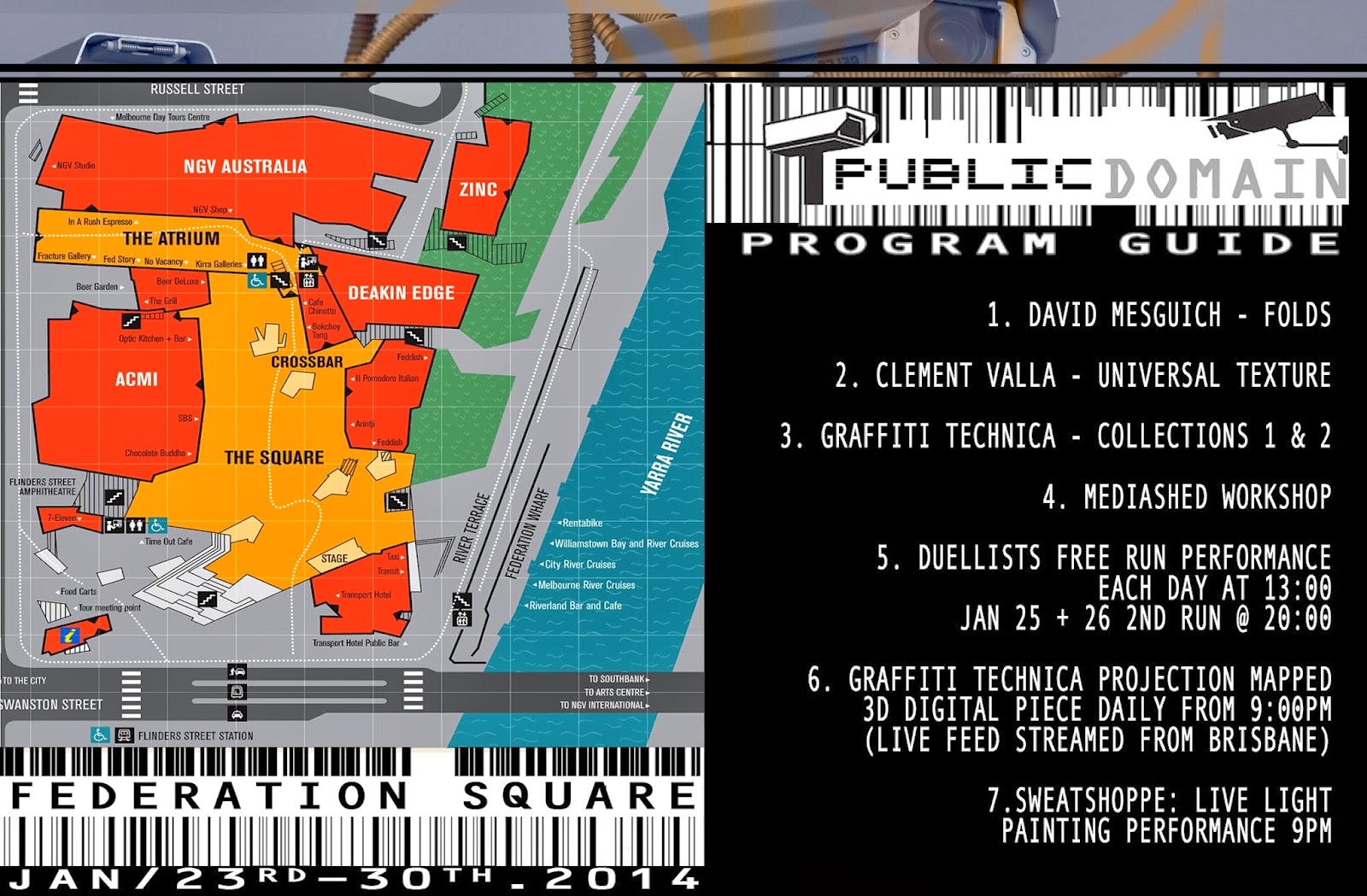
Public Domain illustrates these concepts in both form and function. Utilizing the public space of Federation Square in the Melbourne CBD, the exhibition itself is illustrative of the metanarrative of urban artwork, freely accessible to foot traffic and running from morning through night. The boundaries between these expressions of contemporary Urban art practise and the gallery space are removed as much as logistically plausible, with all artwork referencing the 21st Century crossover point where the lines between the digital and physical are becoming less clear.


In the algorithmic distortions of Clement Valla’s The Universal Texture, the imperfections of the omnipotent eye of Google Earth are laid bare and we see the perfect representation of the modern 21st Century landscape. Rigid manmade structures bend and droop, highway bridges sag as if Dali’s The Persistence of Memory had somehow been captured with a digital SLR. Impossibly flat cities extend out to the horizon across the incorrectly contoured plane, bending and twisting we see our world as a quilt stretched to fit over a mismatched topography. The public space is subject matter of all of these images, The Universal Texture renders the disparity between physical and digital before our eyes.
                                                                                                                                                                   
The exploration of the themes of physicality in the urban landscape have been the obsession of Belgian artist David Mesguich for over 10 years. In previous works such as Crosswords he painstakingly recreated a street landscape from Downtown Manhattan as a wall mounted paper sculpture in miniature, for the purpose of “questionning (sic) the place of the truth in produced images today.” (Mesguich 2008) His sculptural work since has continued to develop this with larger and larger abstracted vector forms and displaying them in public spaces.  Folds, his collaboration piece with painter Valentin Van der Meulen  on display at Public Domain is a 3 metre wide wall mounted sculpture of a skull emerging between two faces constructed from flat vectors of polypropylène. Mesguich’s work is an exercise in bringing these digital 3D modeled forms into the physical world and deploying them in the urban landscape. His work appears almost architectural, his sculptures appearing to emerge organically from their man made surroundings animating it with bold, abstracted facial features. Face perception provides a wealth of information that facilitates social interaction. (Haxby, Hoffman, Gobbini 2002) Due to our predilection for human faces, Mesguich’s work engages our minds in a subliminal dialogue. We apply human characteristics to the urban landscape from which his sculptures emerge, making the inorganic textures of the manmade environment human, through the artifice of digital tools.


Graffiti is irrefutably the foundational element of the Urban Art movement. Synonymous with urbanity for nearly 30 years, the tenets Graffiti art encapsulate the notion of Public space as a battleground where the mutable concepts of intellectual property, individualism & identity are fought. Brisbane artist Graffiti Technica has made his transgressions btween the physical and digital a key feature of his work. By taking fundamental aesthetic forms of modern Graffiti art into the digital realm and manipulating them into animated 3D objects, he has made a career out of contemporising Graffiti art in the 21st Century.


from Graffiti Technica.com, Why?
Why not spray paint?
There is a digital world out there. There are lot of electronic screens, i want to be apart of that world. I want to use the skills that I have acquired to do something different, graffiti to me is a style not an automatic choice of artistic medium. (Graffiti Technica 2009)

The fusion of Parkour and Network Hacking in the collaboration piece by British breaker duo Methods of Movement and London hacker collective Mediashed, The Duellists takes these entirely urban concepts and modernises them in beautifully fluid tangibility. In the spirit of Parkour’s less pretentious title “Free Running” - Mediashed’s information age nerd-anarchy concept of “Free Media” employs the same concept of harnessing and engaging nondestructively with the public space. The commandeering of unprotected wireless signals for the purposes of art is no different to using a bridge as a canvas or a shopping mall as an obstacle course. 

Issues of privacy, surveillance and data security have been at the forefront of ethical debate in the 21st Century. On the surface it may appear that the terrorist attacks of 9-11 may have catalysed the fears posed in Orwellian lore, but surveillance of Public spaces fall under the legislation of the Freedom of Information Act 1982, Public Records Act 1973, The Information Privacy Act 2000 and the Surveillance Devices Act 1999 which all predate this (Brouwer 2012). The Duellists challenge both the public and private enterprise to be confronted the rights of the individual within contemporary society in the digital age. Through the simple act of Free Running, the public is confronted with the consideration of the rights to their own image, identity and recorded copies of it and empowered with the knowledge that they are not passive members of a society but the citizens with the tools to reclaim their own image through freely accessible digital tools. The Duellists as a performance piece illustrates that the concepts of Free Running and Free Media subvert the old world dichotomy of Life and Art as parallel forces in flux and demonstrates that Life is Art.


Light painting takes the rigidity of Projection Mapping and makes it a guerrilla artform. The pioneering multimedia performance work of Bruno Levy and Blake Shaw’s Sweatshoppe uses green LEDs housed inside a paint roller to control the throw boundaries of a nearby projector using a camera to track movement and custom software to perform the operations in realtime. The duo roll up in a van housing the equipment, one leaps out and “paints” the wall with the video feed from the projector covering entire walls with garish Pop art style moving images until the door slams shut and the pair zoom to their next location. The possibilities opened by Sweatshoppe are unique and profound in the context of contemporary urban art. Light Painting not only removes the problematic element of vandalism, but liberates Urban art from the shackles of the static image through digital technology. Finally, visual artists working within the disciplines of street art, graffiti and their related fields are able to move beyond the static limitations of one singular frame. Animated forms can now exist in a live, improvised performative context. The lifelessness of prerecorded antecedent forms of animated Urban artwork bound to immobile projector, CRT, LCD or Plasma screens are a thing of the past. 
Sweatshoppe presents an exciting glimpse into the future of life within the 21st Century, where every surface is a multimedia canvas. The accessibility of this technology is the death knell of the advertising hegemony that controls moving images in the public space. Advertising executives are no longer the gatekeepers of multimedia billboards, a privilege afforded only to corporations with a daily advertising budget that exceeds monthly minimum wage. The ceaseless miniaturization and improved affordability of technology has rendered us with pocket sized projectors and high resolution cameras housed within our smartphones, these portable media drives capable of the computations required to light paint, record the output and stream live to everywhere in the world. This technology costs about 2 weeks wage and can now exist in two pockets of an overcoat. The implications of this cannot be overstated.


Each of these works are a commentary on the juncture between contemporary urban life and the immersive digital age. From the extruded vector forms of David Mesguich and Valentin Van der Meulen’s wall mounted sculpture Folds, to the unconventional abstracted use of depth in the hanging of Clement Valla’s The Universal Texture; the imposition of 3D rendered graffiti forms into filmed locations by Brisbane artist Graffiti Technica or the hacked CCTV captured performances in The Duellists, or live projection based light painting of Sweatshoppe all of the artworks exhibited at Public Domain break the fourth wall and encourage us to step through it, so that we may continue to celebrate and  fight for our own place within the Public Domain.


Bibliography: 


Burnham, J 1968, “Systems Esthetics”, Artforum Vol. 7, No. 1, pp. 30-35, viewed 26 October 2013. 
CROSSWORDS. 2008. CROSSWORDS. Available at: http://www.davidmesguich.com/79131/316210/work/crosswords. viewed 27 October 2013.


Haxby, James V., Elizabeth A. Hoffman, and M. Ida Gobbini. "Human neural systems for face recognition and social communication." Biological psychiatry 51.1 (2002): 59-67.


Graffiti Technica - 3d Graffiti electronic art tagging and mechanical goodness why. 2009. Graffiti Technica - 3d Graffiti electronic art tagging and mechanical goodness why. [ONLINE] Available at: http://www.graffititechnica.com/why.html. viewed 28 October 2013


Brouwer, G.E 2012, Victorian Ombudsman’s Guidelines for developing Closed Circuit Television policies for Victorian Public Sector, pp. 9, Available at: http://www.ombudsman.vic.gov.au/resources/documents/Guidelines_for_establishing_Closed_Circuit_Television_in_public_places_-_Final.pdf viewed 29 October 2013


Victorian Legislation and Parliamentary Documents. 2013. Victorian Legislation and Parliamentary Documents. Available at: http://www.legislation.vic.gov.au. viewed 29 October 2013


Thursday, 17 October 2013

VART3456: Federation Bells Composition

Choosing to attempt this task from one more new perspective proved fatal today.

Still completely unsatisfied with previous attempts (including my initial attempt which ended up being my submitted piece) and with the prospect of being able to perform live from a midi channel in ableton I was drawn to Euclidian Rhythms as a means to realize my initial concept of composing this piece spatially as opposed to melodically. By using duotone or tritone based polyrhythmic loops I would be able to meaningfully connect sets of bells within the space, having them intersect at engaging rhythmic intervals that would appear more dynamic than a standard meter.

By using a midi controller (in this instance a gaming controller/HID, being one of my objectives to incorporate into improvised performance) I could stand within the space and manipulate the rhythmic loops around me gesturally, altering the notes within the loops using another midimapped gesture - coordinating rhythmic and melodic fluctuations purely with two joysticks on the controller.

A further 2 gestures were intended for mapping by clicking in each of the joysticks to
a) retrigger the current loop and b) mute the current note - to add further articulation.

Euclidian Rhythm Approach - Federation Bells Project

Having not allowed sufficient rehearsal time with my new improvisational template, I backed out of using this approach at the last minute and reverted to an edited version of the piece I demoed the previous week.

 
Experiments with Harmony & Dischord - Final Federation Bells Composition

Screenshot of MIDI Sequence for Final Submission


Tuesday, 15 October 2013

HUSO2213: Public Domain: Digital Appropriation of the Urban Landscape


Public Domain: Digital Appropriation of the Urban Landscape
Intercepted transmissions from the battleground of the Post-Individual New media colony.

Curatorial Statement 

Three decades have passed since 1984. At the brink of economic collapse, Proles and Outer Party members alike gather en masse to occupy the Public space outside the Ministry Of Banking,  the central data centre - where man has receded to a custodial role. Representatives acting on behalf of Outer Party members oversee the vast array of global economic data, seas of transactions enacted by hordes of algorithms and calculated within fractions of a nanosecond, the smallest element of life within the datascape, creating the ebb and flow of tides within the ocean of wealth that is the lifeblood of the entire species.

#Newspeak is 140 characters - retweeted to 65,000 followers, 47% of which are human.
Citizens must transmit hourly status updates to the The Ministry of Newsfeed via their Pocket Telescreens. Location Services must be switched on at all times.
If you do not have an account one will be provided for you by the Ministry of Newsfeed. 
We will adjust your privacy settings, please enter all of your details to register.

Your information is valuable to us,  please click here to submit.

------------------------------------------------------------------------------------------------------------------------

Public Domain explores the urban landscape as the battleground where 20th Century notions of intellectual property, individualism & identity are subverted, distorted and are ultimately rendered obsolete.

The artists we present here have been selected due to their awareness of the aforementioned concepts, either beginning their artistic life with the street as their canvas and moving into a gallery setting or at pioneering new methodology in taking their craft into the Public Domain - keeping this medium engaging and very much a contemporary practice.

Public Domain explores the relationship of the Urban landscape to the Digital landscape as contemporary society increasingly move to an existence that traverses both in simultaneity. As we walk to the station glued to our smartphones to sit down in the carriage we exist in both the digital and physical public space briefly puncuated only by the 90 seconds of no service in the city loop.

Public Domain also explores the urban landscape as an artform within itself.
Public Domain also explores the datascape as an artform within itself.

Whether painted on a building or a jpg hosted on a server, these artworks serve as footprints, watermarks, artifacts - real or the digital, left by by individuals moving within the Public Domain.